


My father, Lieutenant-Colonel Gérard Leclerc, was born on September 11, 1919. When Canada declared war on Germany in September 1939, he
was 20 years old and enlisted in the armed forces shortly thereafter, voluntarily. He told his father, “I joined the army as a private; I’ll come out an officer.” Following the enactment of the 1940 Mobilization Act, my father officially enlisted in March 1941 and quickly rose from corporal to sergeant in a single year.
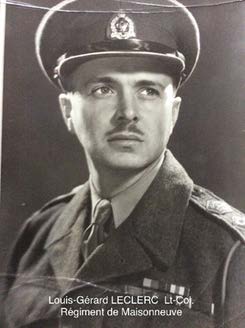
In early 1942, he was recommended by the army to undertake officer training in Brockville, Ontario, and by April, he had earned his officer’s commission. It was with the rank of Lieutenant in the Voltigeurs de Québec that he left Quebec in September 1943 via Halifax for the crossing to England. There, he underwent intensive training in preparation for the Normandy landings. Meanwhile, he joined Le Régiment de Maisonneuve and was stationed in Brighton and then Folkestone. Due to a series of circumstances and logistical issues, it wasn’t until July 7, 1944, that my father and his Regiment set foot on French soil. This was more than a month after the famous landings of June 6.
The French campaign thus began for Lieutenant Leclerc and his Regiment. Their mission was to liberate French villages from Nazi occupation and push back the German enemy into Belgium, the Netherlands, and even into their own country: Germany. The Maisonneuve Regiment went into action on July 13th and, until the end of August, succeeded in dislodging the enemy, house by house, from several small French villages. Among them was Bourgtheroulde, where my father, Lieutenant Leclerc, had received orders to seize a hill, a strategic point for future assaults. He had only 11 men under his command and, at his suggestion, had requested armored vehicles equipped with machine guns from his commander. With this initiative, he managed to reach the hilltop and took several enemy prisoners without losing a single man.
It is now September 10, 1944. Lieutenant Leclerc receives orders to command the lead platoon, which will draw enemy fire to relieve the Black Watch Regiment, which is in difficulty nearby. Around 5:00 p.m., Leclerc and his men arrive at the edge of a small hamlet called Craywick, where they encounter French resistance fighters from the FFI (French Forces of the Interior) who tell them: “Don’t go there, gentlemen Canadians, the Germans are here.” And my father replies: “So much the better, that’s what we’re looking for, Germans, and we came here to win the war.” Still in the same area, and after a few tentative advances, the men from the Maisonneuve Regiment were approaching the enemy, who were waiting for them with a fierce barrage of machine-gun fire. The platoon was suddenly trapped. My father, Lieutenant Leclerc, lost his sergeant, and almost simultaneously, his commanding officer was hit and put out of action. The latter ordered my father to take command of the company. His objective was to protect his men and move away from the enemy fire in order to bring his soldiers back to safety. But the return route was entirely mined. Undeterred, Lieutenant Leclerc advanced at the head of his company, followed by another lieutenant and a sergeant. He told them that he would take the lead and that if he stepped on a mine, the lieutenant would have to take his place, and if he too was struck, it would be the sergeant’s responsibility to lead the company out of that situation.
Lieutenant Leclerc then headed towards the road, praying for divine intervention to ensure his soldiers’ safe return to the battalion lines. For my father, every step could mean the end. With such audacity and courage, the operation was a success. For this act, my father earned a commendation and was awarded a medal. My father and the men of the Maisonneuve continued their fierce fighting in Belgium, the Netherlands, and finally Germany, where they remained until May 8, 1945, the date of the armistice ending hostilities in Europe. My father was promoted to Adjutant and did not return to Quebec until mid-November 1945. Always with his characteristic discipline and determination, Adjutant Gérard Leclerc became a Major in 1952 and a Lieutenant Colonel in 1954. Returning to civilian life after the war, my father, still as ambitious as ever, continued to bring honor to our immediate family and, by extension, to all the Leclerc. He worked for the Municipal Services of the City of St-Hubert for 24 years (1960-1984) and ended his career there as Director General and Industrial Commissioner of the Saint-Hubert Economic Corporation, as well as Director of the Association of Industrial Commissioners of Quebec.
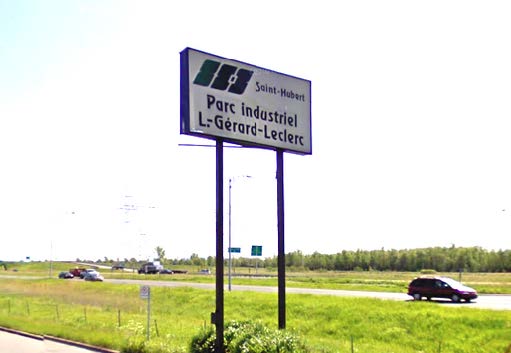
During his meteoric career, it was at his instigation that city officials recognized the need to create an industrial fund to provide the municipality with an industrial park, and also, at his recommendation, that an Economic Development Corporation was created in 1984. In recognition of his loyal service, the City of Saint-Hubert inaugurated an industrial park in 1987, located along Highway 30 and named after L. Gérard Leclerc, prominently displayed on a giant sign overlooking the park. This tribute contributes to the pride of the extended Leclerc family.